Pages
Pages
Arrow Right Black
Arrow Right Black
Slot Icon

Learn Studio Lighting

Ultimate V-Flats Guide for Studio Photography | How to Use White & Black Fill

Learn how to use V-flats for studio lighting—white vs black, shaping faces, sculpting clothing, product setups, mistakes to avoid, and setups for every genre.

The Ultimate Guide to V-Flats for Photography (2025 Edition)

How to Use, Build, Position, and Master V-Flats for Studio Lighting, Natural Light, Portraits, Fashion & eCommerce

V-flats are one of the most versatile, misunderstood, and under-utilised lighting tools in photography. They’re inexpensive, lightweight, and deceptively simple — yet they can dramatically change the way light wraps, shapes, and defines your subject. From soft beauty portraits to high-contrast editorial setups, from natural light control to commercial product shoots, V-flats give you professional-level light manipulation without needing extra lights or expensive modifiers.

But most guides barely scratch the surface. They explain bounce vs negative fill, maybe show you a portrait example, and stop there.

This guide goes all the way.

You’re about to learn:

  • How V-flats actually change the physics of light (not just “white bounces / black absorbs”)
  • The exact angles, distances, and heights to place your V-flats for different lighting results
  • How to use V-flats with strobes, continuous lights, natural light, and mixed-light setups
  • The differences between V-flats made from polyboard, foam core, and commercial V-flats
  • How to use V-flats for portraits, fashion, beauty, eCommerce, and reflective products
  • How to build durable DIY V-flats in Australia — including exact board sizes, paint types, and tape options
  • How to stabilise, store, transport, and maintain them safely in a working studio
  • Advanced techniques used in professional studios: cove extension, edge gradients, subtractive lighting, and shaping body lines
  • Small studio techniques where space is limited
  • V-flats inside Bohemia Bay Studio’s LightRight™ grid (mapping your setups to exact repeatable zones)

This isn’t just a guide — it’s the central chapter of Bohemia Bay Studio’s full Lighting Education Hub.
It’s designed to help photographers at every level build competence, confidence, and control in the studio.

Why V-Flats Matter More Than Most Photographers Realise

V-flats solve multiple lighting problems at once:

  • You need softer shadows → use white bounce
  • You need deeper shadows → use black negative fill
  • You need to block spill from a softbox → use a V-flat wall
  • You need a clean backdrop → use the white panel
  • You need subject separation → use black to carve shape
  • You need a natural-light modifier → use one side as a faux window
  • You need to control reflections on glossy products → build a V-flat tunnel
  • You need to pack your kit efficiently → they fold, hinge, or stack

They’re fast.
They’re predictable.
And they work in both beginner and high-end setups.

Yet many photographers never learn to use them properly — or think they’re “just for portraits.”

This guide changes that.

By the end, you’ll understand not just how to use V-flats…
…but how to think with them — to shape light intentionally, consistently, and professionally.

What Makes This the Most Complete V-Flats Guide on the Internet

Most guides fall short because they:

  • Ignore Australian sizes & suppliers
  • Don’t explain why certain placements work
  • Don’t cover continuous vs strobe differences
  • Don’t explain negative fill properly
  • Don’t provide real measurements or distances
  • Skip product photography entirely
  • Don’t show how V-flats help shape bodies, faces, and clothing
  • Don’t address safety
  • Don’t include natural light setups
  • Don’t cover small studio limitations
  • Don’t show how V-flats integrate into a full lighting workflow

This guide covers all of that — and more — in structured, easy-to-follow sections that blend professional lighting theory with real, repeatable setups.

Before We Dive In

This guide is part of the Bohemia Bay Studio Lighting Hub, including:

  • Strobe vs Continuous
  • What Is Continuous Light
  • One-Light Setups
  • Two-Light Setups
  • Natural Light Setups
  • Constant Light Setups
  • Polyboards & Negative Fill

Each guide links to the others so beginners can learn progressively — and professionals can refine specific techniques.

At the end of this guide, you’ll find:

  • a quick-reference chart
  • a downloadable cheatsheet
  • links to visual diagrams
  • a demonstration video (you’ll insert later)

For now, let’s begin.

How V-Flats Work (The Real Physics Behind Them)

Light does three things when it hits a surface:

  1. Reflects
  2. Absorbs
  3. Scatters

V-flats use this to your advantage:

V-Flat Surface Effect on Light
White Side – Reflective Fill
  • Adds soft bounce
  • Lifts shadows
  • Smooths skin
  • Reduces overall contrast
  • Wraps light around the face/body
  • Creates a larger effective light source (bigger = softer)
Ideal for beauty, eCommerce, lifestyle, and soft editorial looks.
Black Side – Negative Fill
  • Absorbs light instead of bouncing it
  • Deepens shadows
  • Adds dimensionality & sculpting
  • Defines cheekbones, jawlines, and clothing folds
  • Reduces spill from softboxes & windows
  • Prevents “white studio syndrome” (light bouncing everywhere)
Perfect for portraits, fashion, and creating premium, commercial contrast.

The V Shape → Stability + Light Control

The V shape creates stability (it stands without a stand), but it also creates:

  • Controlled channels of light
  • Soft tunnel light for products
  • Natural wrap for portraits
  • Perfect edge gradients for eCommerce
  • Directional light shaping without more gear

Changing one angle changes the entire mood.

Standard Sizes (Australia-Friendly)

In Australia, you’ll most commonly see:

  • 2400 × 1200 × 50 mm polyboard sheets (default hardware-store size)
  • White on both sides — you’ll paint one side black
  • 40–50 mm thickness = stable enough to stand

These are the exact boards we use and recommend at Bohemia Bay Studio.

Commercial V-Flats (V-Flat World, etc.)

Pros: lightweight, foldable, durable
Cons: expensive to ship to Australia, smaller surface area, less stable

Foamcore

Pros: light, inexpensive
Cons: too thin — falls over, warps, breaks easily ▶ Not recommended

Why V-Flats Matter When You Hire a Studio

V-flats aren’t just a lighting tool—they’re one of the fastest ways to improve the quality of your shoot when you book a professional studio. Whether you’re shooting portraits, products, campaigns, or beauty work, V-flats give you instant control over:

  • Shadow depth (with black negative fill)
  • Soft, even illumination (with white bounce fill)
  • Background separation
  • Refining face shape and body contouring
  • Reducing glare or spill from large white studio walls

The reason this matters for studio hire is simple:

A studio gives you the space, but V-flats give you the control.

They turn any lighting setup—strobe, continuous, or natural—into something more precise and repeatable. In our Melbourne studio, V-flats are available at no charge and positioned near mapped lighting zones, so you can walk in, place them, and immediately achieve cleaner light, better contrast, and more professional results without needing a lighting assistant.

If you’re hiring the space for e-commerce, portraits, lookbooks, campaigns, UGC, or personal branding, mastering V-flats is one of the easiest ways to level up your shoot quality from the moment you walk through the door.

Why Every Working Photographer Should Use V-Flats

V-flats solve six major lighting problems:

1. They Give You Soft, Professional Light — Instantly

White bounce can turn a harsh light into a soft one.
Great for: beauty, headshots, full-body fashion, lifestyle, products.

2. They Shape Faces and Bodies for Commercial Looks

Black negative fill sculpts cheekbones, jawlines, arms, and clothing folds.
This is how high-end fashion and portrait shooters create dimensionality.

3. They Let You Control Natural Light

With natural light, you can:

  • bounce sunlight from the floor
  • block spill from huge windows
  • reduce ambient contamination
  • create faux-window directional light

4. They Replace Multiple Lights

One strobe + two V-flats can look like a three-light setup.

5. They Control Reflections on Shiny Products

Essential for:

  • cosmetics
  • packaging
  • glass
  • bottles
  • metals
  • skincare products

V-flats create clean gradients and prevent unwanted reflections.

6. They Help Beginners Avoid “Flat Lighting Syndrome”

Most beginners overfill a scene or use too much white space.
Black V-flats fix this fast.

  • V-flats act as “shape modifiers”
  • They refine how key light, fill, or natural light interacts with the subject
  • They provide repeatable setups mapped to physical zones (A–H)
  • They allow beginners to recreate world-class lighting with minimal theory

Types of V-Flats (DIY, Polyboard, Commercial, Foamcore & Foldable)

Not all V-flats are made equal. Some are perfect for professional studios, some for beginners, and some aren’t worth the effort.
This section breaks down every major type — including real-world pros, cons, and when you should (and shouldn’t) use each.

1. DIY Polyboard V-Flats (The Industry Standard in Australia)

Best for: Photography studios, commercial work, portraiture, eCommerce, beauty, fashion
Material: Hardware-store polystyrene sheets (2400 × 1200 × 50 mm)
Cost: $40–$60 per sheet

This is the most common and most effective V-flat in Australia because polyboard is cheap, huge, and incredibly effective at shaping light.

Pros Cons
  • Massive surface area → softer bounce & stronger negative fill
  • Ultra-lightweight → easy to reposition during a shoot
  • Very affordable
  • Ideal for large-scale fashion & eCommerce work
  • Produces clean, beautiful gradients on products
  • Stable when taped or hinged into a V shape
  • Often arrive white on both sides → requires painting one side black
  • Edges can dent easily if mishandled
  • Require adequate transport/storage space (full 2.4m length)

Verdict

This is the gold standard for a reason. Every major Melbourne, Sydney, and Brisbane studio uses these.

2. Commercial V-Flats (e.g., V-Flat World, foldable sets)

Best for: Photographers with limited space, studio owners who travel, premium setups
Material: Foldable foam-core panels with fabric hinges
Cost: $350–$600+ per set

These are pre-made V-flats sold by brands like V-Flat World. Excellent quality, beautifully designed — but expensive and harder to source in Australia.

Pros Cons
  • Foldable → easy to store and transport
  • Durable foam-core construction with crisp edges
  • Pre-painted black/white for instant use
  • Consistent, professional finish
  • Great for home studios and small shooting spaces
  • Very expensive to ship to Australia
  • Smaller footprint → less effective for full-body bounce
  • Lightweight → can be less stable in large, open studios

Verdict

Gorgeous but pricey. Great if you want beautiful gear or have limited space, but polyboard still performs better for most commercial photoshoots.

3. Foamcore V-Flats (Thin, Lightweight, Hobby-Grade)

Best for: Beginners, small product photography, tight spaces
Material: Thin foamboard (5–10 mm)
Cost: $10–$30 per sheet

These look nice but aren’t suitable for professional shoots.

Pros Cons
  • Cheap
  • Lightweight
  • Easy to tape together into makeshift V-flats
  • Too thin → falls over easily
  • Warps with humidity or temperature changes
  • Reflects inconsistently → results can look amateur
  • Fragile → dents or creases very easily

Verdict

Use only for tabletop or very small setups. Not recommended for people, fashion, or full-size products.

4. PVC or Corflute V-Flats

Best for: Outdoor shoots, events, mobile setups
Material: Corrugated plastic (corflute), PVC sheets
Cost: $30–$70 per sheet

These are often used by event photographers because they’re more weather-resistant than polystyrene.

Pros Cons
  • More durable than polyboard
  • Water-resistant
  • Easy to clean
  • Lightweight for moving around during a shoot
  • More reflective → can create hotspots
  • Bounce isn’t as soft as polystyrene
  • Black side isn’t as light-absorbing as matte-painted polyboard
  • Flexes or wobbles in airflow

Verdict

Good for mobile or event shooters, but not ideal for controlled studio work where softness and consistency matter.

5. Foldable Fabric V-Flats With Velcro Frames

Best for: Travelling photographers, location studios
Material: Lightweight aluminium frame + reversible fabric covers
Cost: $180–$350

A relatively new category: compact, portable V-flats designed for travel kits.

Pros Cons
  • Packs down small (fits in car boot)
  • Soft fabric absorbs and bounces light gently
  • Lightweight frame
  • Ideal for on-location shoots
  • Weaker bounce compared to solid polyboard
  • Fabric can wrinkle → inconsistent light falloff
  • Requires assembly/set-up time

Verdict

Fantastic for location lifestyle shoots, not strong enough for high-end studio shaping.

6. Painted MDF or Plywood V-Flats

Best for: Permanent studio installations
Cost: $30–$60 per sheet

Rare these days, but useful in some situations.

Pros Cons
  • Very durable and long-lasting
  • Can be colour-matched to your studio aesthetic
  • Stable when mounted or secured to stands
  • Heavy compared to foam options
  • Can be hazardous if they tip over
  • Highly reflective unless painted ultra-matte

Verdict

Only suitable if permanently installed and safely anchored.

So Which V-Flat Should You Choose?

If you’re a professional photographer
👉 Choose DIY polyboard V-flats (2400 × 1200 × 50 mm)
They offer the best balance of size, softness, price, and performance.

If you’re shooting on location
👉 Choose foldable fabric V-flats or commercial foldable V-flats

If you’re a beginner or working in a small space
👉 Foamcore is okay only for tabletop or product work.

If you’re building a permanent studio
👉 Painted MDF can work but is not ideal for shaping light.

How to Use V-Flats: 12 Essential Setups Every Photographer Should Know

V-flats are at their best when they’re used practically — shaping, subtracting, or controlling light to create professional, repeatable results.
Below are the twelve most useful lighting setups, covering everything from soft beauty looks to dramatic editorial portraits.

Each setup includes:

  • What it is
  • How to place your V-flat
  • Where to position your light
  • Best distance / angles
  • What the final image looks like
  • Best for

This section is designed to be skimmable, bookmarkable, and studio-ready.

Classic Beauty Bounce (White-In V-Flat Wrap)

What it does

Creates ultra-soft, glowing light with lifted shadows and smooth skin tone transitions.

How to set it up

  • Place the V-flat in front of the subject, white sides facing inward, forming a shallow V.
  • Put your key light (usually a large softbox or octa) directly behind you, pointing toward the subject.
  • The V shape wraps the light around the face.

Distance

V-flat: 30–60 cm from the subject’s shoulders
Light: 1–1.5 m from the subject

Result

✨ Smooth, youthful skin
✨ Soft catchlights
✨ Even fill across the face

Best for

Beauty, skincare, headshots, jewellery, eCommerce models.

Negative Fill Sculpt (Black-In, 45°)

What it does

Adds contrast and definition to cheekbones, jawlines, and clothing folds.

How to set it up

  • Position your key light 45° to the subject (standard portrait orientation).
  • Place the V-flat on the shadow side, black side facing inward, around 30–60 cm from the face/body.

Result

🔥 Stronger shadows
🔥 More depth and dimensionality
🔥 A more expensive, editorial look

Best for

Men’s portraits, fashion, moody branding, fitness.

“Half Dome” Beauty (White Bounce on One Side Only)

What it does

Creates a soft but directional light with controlled falloff.

Setup

  • Key light at 45°.
  • One white side of the V-flat placed parallel to the subject on the fill side.
  • The other side folded away.

Result

Smooth highlight-to-shadow transition without losing shape.

Best for

Modern beauty, editorial portraits, clean eCommerce.

Full-Body Fashion Fill

What it does

Adds soft, even illumination across the entire body for consistent lookbook or campaign shots.

Setup

  • Position a V-flat one metre to the side of the subject, white side facing inward.
  • Angle it slightly toward the light, not the subject.

Result

🕊 Softened shadows head-to-toe
🕊 More even exposure for clothing textures

Best for

Lookbooks, model digitals, eCommerce fashion.

Deep Contrast Fashion (Black Walls)

Setup

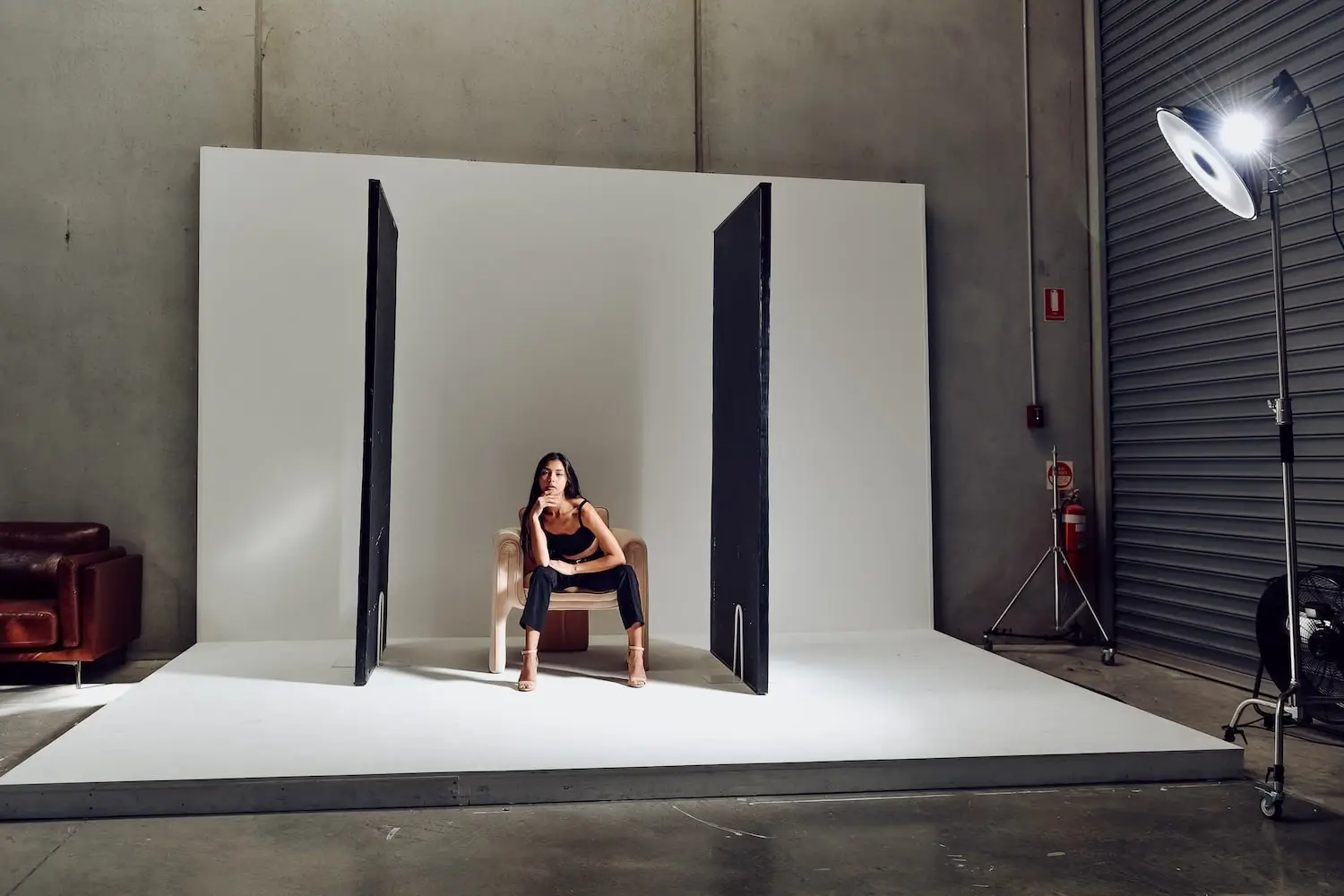
  • Place two V-flats around the subject, black sides inward — creating a “contrast tunnel.”
  • Key light at 45°.
  • Bring V-flats closer for harder shadow definition.

Result

⚫ Bold, sculpted shadows
⚫ High-fashion editorial
⚫ Extreme dimensionality

Best for

Editorial, fitness, dramatic menswear.

Product Gradient Control (White Parallel Boards)

What it does

Creates perfect, clean gradients on reflective surfaces.

Setup

  • Place product in the centre.
  • Place both V-flat wings parallel and white-side facing in to create clean edge reflections.
  • Fire key light into one board to bounce toward the product.

Result

✨ Luxury gradients
✨ Clean highlights on bottles, cosmetics, packaging

Best for

Skincare, beauty, FMCG, reflective products.

Product Silhouette Blocking (Black Parallel Walls)

What it does

Deepens shadows and accentuates shape.

Setup

  • Use black sides of both V-flats.
  • Position them parallel, close to the subject.
  • Shoot light from above or 45°.

Result

Strong shape, high contrast, dramatic edges.

Best for

Luxury cosmetics, fashion accessories, food/hero shots.

Window Light Amplifier (White Bounce Into Natural Light)

What it does

Boosts natural light from a window without adding harsh shadows.

Setup

  • Place V-flat white side facing the window.
  • Position subject opposite the board.
  • Use the V-flat as a massive reflector.

Result

Soft, glowing, natural feel — perfect consistency.

Best for

Lifestyle portraits, branding shoots, kids/babies.

Window Light Negative Fill (Black Near the Shadow Side)

Setup

  • Window to one side.
  • Subject facing the window.
  • Place V-flat black side opposite the window 30–60 cm from subject.

Result

Sharper shadows, more directional feel, added mood.

Best for

Moody natural-light portraits, creative editorial.

Backlight Blocker (Preventing Spill Behind Subject)

What it does

Stops light from wrapping too far around your subject.

Setup

  • Place a black V-flat behind the subject on the side of the key light.
  • Blocks stray light from hitting hair/cheek.

Result

Cleaner profiles, stronger mood, crisp edges.

Best for

Split lighting, film-style portraits.

On-Set Privacy / Distraction Blocker

Not strictly a lighting setup — but extremely useful.

What it does

Creates a clean zone around the subject, reducing distractions or movement behind camera.

Setup

  • Use V-flat (white or black) behind or beside camera.
  • Especially useful during commercial productions with crew.

Result

More focus, less reflection, calmer subject.

Faux-Wall Light Shaping

What it does

Simulates shooting against a wall for directional light shaping.

Setup

  • Put V-flat behind the subject at a 45-degree angle.
  • Light bounces off or is blocked by the board, giving a “room corner” effect.

Result

Modern editorial look, great for small studios.

White vs Black V-Flats: When to Use Each (And Why Most Photographers Get This Wrong)

V-flats are simple — but choosing the right side (white vs black) is where the real skill lies.
Most photographers overuse white and underuse black, leading to flat, washed-out, low-contrast images that feel “cheap.”

This section teaches readers how to use each side with intention — and how subtle shifts completely change the mood, shape, and professionalism of an image.

What White V-Flats Actually Do

White = add light, soften shadows, smooth transitions, wrap illumination.

But the important nuance is this:

👉 White doesn’t just “brighten” — it increases the size of your light source.
A bigger source = softer, smoother light.

Category Details
What White V-Flats Do
  • Add light + soften shadows
  • Smooth transitions and wrap illumination
  • Increase the effective size of your light source
  • Create softer, more flattering images
Best Used For
  • Beauty & skincare
  • E-commerce fashion / lookbooks
  • Content creation & social media
  • Corporate headshots
  • Baby / lifestyle photography
  • Soft natural-light enhancement
Use When You Want
  • Soft, glowing light
  • Cleaner skin + fewer shadows
  • Gentle transitions on clothing
  • Head-to-toe flattering light
  • To brighten a dim studio/natural light space
  • To reduce micro-contrast
What White Can Do Wrong
  • Can flatten the image
  • Over-smooths texture
  • Reduces dimensionality
  • Makes men's portraits look overly “pretty”
  • Can reflect onto shiny surfaces/products

This is why photographers who only use white boards get stuck in a “same look” rut.

6.2 What Black V-Flats Actually Do

Black = remove light, increase contrast, tighten shadows, sculpt features, control spill.

If white is additive, black is subtractive.

👉 Black doesn’t create shadows — it protects them.
This is the difference between amateur and pro lighting control.

Category Details
What Black V-Flats Do
  • Remove light (subtractive fill)
  • Increase contrast
  • Tighten & deepen shadows
  • Sculpt cheekbones, jawlines, and body contours
  • Control spill from softboxes/windows
  • Protect shadow areas rather than creating new ones
Best Used For
  • Fashion editorials
  • Menswear
  • Fitness photography
  • Film-style portraits
  • Dramatic branding imagery
  • Sculpted beauty
  • Dark/moody product photography
Use When You Want
  • Stronger cheekbones
  • Better jawline definition
  • Heightened overall contrast
  • More cinematic mood
  • Better tonal separation in clothing
  • Depth, drama, and sculpting
What Black Can Do Wrong
  • Can be too harsh for corporate or eCommerce lighting
  • Can exaggerate texture or age skin when used strongly
  • Shadows tighten quickly — small movements = big changes

This is why precision matters.

6.3 The Simple Rule (That Works 95% of the Time)

Here’s the rule I teach beginners and professionals alike:

👉 If you want to flatter, use white.
If you want to sculpt, use black.

And here’s the pro-level refinement:

👉 Use white to fill shadows you don’t want.
Use black to protect shadows you do want.

This is the mindset shift that transforms your lighting.

6.4 The Hybrid Method (A Pro Secret)

One of the best techniques is combining white and black at the same time:

White on the key-light side

Fills shadows + extends the wrap of your key light.

Black on the opposite side

Protects sculpting shadows + adds definition.

This creates a “premium portrait look” used in:

  • luxury skincare
  • Nike/Adidas athlete portraits
  • GQ-style menswear
  • fashion campaigns

It's balanced and dimensional — the perfect middle ground.

6.5 The Distance Rule (Critical but Overlooked)

Whether you use white or black, distance controls intensity.

Here’s the cheat sheet:

DistanceEffect< 30 cmHeavy effect — strong fill or strong negative fill30–60 cmMedium, natural effect60–100 cmLight, subtle effect> 1 metrePractically no effect

The closer the V-flat, the more powerful its influence.
This is why moving a V-flat 20 cm can change the entire mood.

6.6 How Black and White Affect Skin Types

To give this guide real-world depth:

White on Skin Black on Skin
  • Smooths overall skin texture
  • Reduces visible blemish contrast
  • Softens nasolabial shadows
  • Makes oily/highlighted areas appear more diffused
  • Adds depth and sculpting to the face
  • Can emphasise pores and skin texture
  • Increases shine contrast on cheekbones + high points
  • Great for jawlines, but not always flattering for forehead shine

Pro tip:
Many photographers use black for men and white for women.
But the better approach is to use the style, not the gender, as the deciding factor.

6.7 How Black and White Affect Clothing

White Fill Black Fill
  • Softens wrinkles and creases
  • Brightens colours and fabrics
  • Creates smooth transitions across garments
  • Excellent for fast-moving eCommerce workflows
  • Defines edges, seams, and folds
  • Reveals texture in knitwear, tailoring, denim
  • Adds dimensionality to monochrome outfits
  • Ideal for premium, luxury, and editorial fashion brands

This is why styling teams often request black fill for editorial and white fill for catalogue.

6.8 How Black and White Behave with Natural Light

With Window Light:

  • White brightens and softens (especially on cloudy days)
  • Black adds shape (especially near large open roller doors)

With Harsh Sun:

  • White tames harsh shadows
  • Black creates dramatic, cinematic contrast

With South-Facing Soft Light:

  • White amplifies softness
  • Black adds sophistication and depth

At Bohemia Bay Studio, both our north and south doors create unique behaviours:

  • South door (soft light): white = glow, black = subtle definition
  • North door (hard light): white = relief, black = powerful drama

This is a massive advantage your guide can explain better than any competitor.

6.9 Choosing the Right Side Based on Photography Genre

Genre Use White Use Black
Beauty ⭐⭐⭐⭐⭐ ⭐⭐⭐
Skincare ⭐⭐⭐⭐⭐ ⭐⭐⭐
Menswear ⭐⭐⭐ ⭐⭐⭐⭐⭐
Fitness ⭐⭐⭐ ⭐⭐⭐⭐⭐
E-commerce ⭐⭐⭐⭐⭐ ⭐⭐
Editorial Fashion ⭐⭐⭐ ⭐⭐⭐⭐⭐
Corporate ⭐⭐⭐⭐⭐
Product (Shiny) ⭐⭐ ⭐⭐⭐⭐⭐
Product (Matte) ⭐⭐⭐⭐⭐ ⭐⭐⭐
Lifestyle ⭐⭐⭐⭐⭐ ⭐⭐⭐

7. V-Flat Setups for Portraits, Products & Natural Light (Quick Master Guide)

V-flats are uniquely powerful because they adapt to any style, light source, or creative direction.
This section gives you the core setups photographers use daily across portraits, eCommerce, beauty, and natural light shoots.

These are the foundational setups — the ones every great lighting system (including LightRight™) builds from.

7.1 Portrait Photography V-Flat Setups (Soft, Sculpted & Editorial Looks)

Portraits are where V-flats shine the most.
Whether you're shooting beauty, corporate, menswear, fitness, or editorial fashion, V-flats give you the fastest, most predictable control over shape, contrast, and contour.

Below are the essential portrait setups you can use at Bohemia Bay Studio — no matter your skill level.

1. White Wrap Beauty Light (Classic Soft Portrait)

Purpose: Ultra-soft, flattering, clean beauty light
How it works:

  • White sides inward
  • Light angled slightly above the lens
  • Boards positioned close to the subject
  • Softens shadows + reduces micro-contrast

Gives you:
✨ Glowing skin
✨ Soft, gentle transitions
✨ Natural, even tones

Best for:
Beauty, skincare brands, female portraits, eCommerce headshots.

2. Black Side Sculpt (Fashion & Men’s Portraits)

Purpose: Add controlled contrast + shape
How it works:

  • Black side positioned on the shadow side
  • Close distance = stronger sculpt
  • Protects shadows from unwanted fill

Gives you:
🔥 Strong cheekbones
🔥 Dimensionality
🔥 A “premium editorial” look

Best for:
Menswear, fitness, moody branding, editorial portraits.

3. Hybrid Setup (White on Key Light Side, Black on Shadow Side)

Purpose: Combine softness + shape
How it works:

  • White V-flat to extend the key light
  • Black V-flat to preserve shadow definition

Gives you:
Mix of flattering + dimensional
Perfect balance for brands who want “polished but real.”

Best for:
Modern personal branding, fashion/lifestyle, commercial portraits.

4. Full Tunnel Negative Fill (Dramatic Editorial)

Purpose: Maximum contrast
How it works:

  • Two V-flats arranged like a narrow hallway
  • Black sides inward
  • Key light at 45°

Gives you:
⚡ Bold, chiseled shadows
⚡ High-contrast editorial depth
⚡ Cinematic mood

Best for:
Mens editorial, fitness, music portraits, dramatic campaigns.

5. High-Key Beauty Fill (White-On-White Setup)

Purpose: Create smooth, flawless high-key light
How it works:

  • White V-flats on both sides
  • Background also lit
  • Minimal shadow + low contrast

Gives you:
Soft, commercial beauty look often used in cosmetics ads.

Best for:
Skincare, haircare, jewellery, clean eCommerce.

7.2 Product Photography V-Flat Setups (Gradients, Shape Control & Spill Management)

Products — especially shiny ones — require precise light control.
V-flats make this incredibly easy without buying specialised reflectors or custom modifiers.

1. Parallel White Walls (Clean Luxury Gradients)

Purpose: Create smooth gradients on reflective surfaces
Setup:

  • Product centered between two white panels
  • V-flats parallel, not angled
  • Light fired into one panel to bounce back

Gives you:
✨ Luxury gradients
✨ Minimal reflections
✨ Premium “high brand” look

Best for:
Cosmetics, skincare, glassware, jewellery, bottles.

2. Black Silhouette Walls (Shape & Shadow Definition)

Purpose: Deep contrast + sculpted edges
Setup:

  • Black V-flats parallel to product
  • Light from above or angled at 45°

Gives you:
Rich shadows + defined edges
Ideal for moody, dramatic product campaigns.

Best for:
Premium fashion accessories, dark packaging, editorial products.

3. Bounce Box (Soft E-Commerce Light)

Purpose: Even lighting for catalogue eCommerce
Setup:

  • White V-flats positioned close on both sides
  • Creates a soft “light tent” effect
  • Key light from above or at 45°

Gives you:
Consistent soft shadows, easy retouching, fast workflow.

Best for:
Ecommerce products, clothing flats, soft goods.

4. Background Gradient Control

Purpose: Smooth backgrounds without specialised backdrops
Setup:

  • White V-flat close to background on one side
  • Light fired into board, not straight at backdrop

Gives you:
Beautiful roll-off from highlight to midtone
Perfect for glossy campaigns.

7.3 Natural Light V-Flat Setups (Control Sunlight Without Extra Gear)

This is where your studio absolutely shines (pun intended).
Because Bohemia Bay has both north-facing hard light and south-facing soft light, V-flats become the perfect natural-light modifiers.

1. South Light Soft Bounce (White Fill for Lifestyle & Branding)

Purpose: Amplify soft daylight from roller door
Setup:

  • White V-flat facing the south door
  • Subject on opposite side
  • Use board to brighten and wrap light

Gives you:
Clean, airy, glowing natural light.

Best for:
Personal branding, lifestyle, kids, soft fashion.

2. North Light Contrast Control (Black Negative Fill for Drama)

Purpose: Sculpt shape in harder natural light
Setup:

  • Subject angled slightly into north light
  • Black V-flat opposite light
  • Close placement = stronger shadows

Gives you:
Fashion editorial vibes with zero artificial lighting.

Best for:
Moody portraits, editorial fashion, dramatic product shots.

3. Window-to-V-Flat Bounce (DIY Large Softbox)

Purpose: Turn window light into a giant softbox
Setup:

  • Light hits white V-flat
  • Bounce reflects back onto subject
  • Works in small studios / tight corners

Gives you:
Soft, controlled fill without extra gear.

4. Natural Light Tunnel (High-Contrast Lifestyle)

Purpose: Shape natural light into a clean directional look
Setup:

  • Black V-flats forming a subtle tunnel
  • Subject just inside shade line
  • Hard light controlled but not eliminated

Gives you:
Sharp edges, interesting shadows, clean dimension.

Best for:
Editorial lifestyle, fitness, fashion.

7.4 Advanced Lighting Techniques with V-Flats (Pro Methods)

These are the setups that separate hobbyists from working photographers.

1. Light Choking (Spill Reduction)

Block unwanted wrap from large softboxes or windows.
Great for controlling cheek highlights or clothing shine.

2. Book-Ending

Two V-flats opposite each other act as shadow “walls,” tightening contrast.
Perfect for editorial menswear.

3. Side-Flagging

Position black board just outside frame to selectively remove fill on one edge of the face.

4. Gradient Sculpting

Aim key light into a white V-flat rather than directly at the subject.
Produces buttery-smooth sculpting across skin or fabric.

5. Edge Blocking for Natural Light

Use black V-flat just behind the subject to stop ambient wrap from windows.

6. One-Light Expansion

Combine one strobe with a white V-flat to create “two-light” results.
Perfect for beginners.

8. Common V-Flat Mistakes (And How to Fix Them Fast)

V-flats are simple tools, but small errors in placement or angle can dramatically change your results.
This section walks through the most common mistakes photographers make and gives quick, practical fixes for each.

8.1 Mistake: Using Only the White Side (Everything Looks Flat)

The problem:

The Problem Symptoms How to Fix It
Beginners overuse white because it feels “safe,” but too much bounce light kills dimensionality and makes everything look flat.
  • Low contrast
  • Soft but bland lighting
  • No shaping in the face
  • Clothing looks dull
  • “Cheap eCommerce” look
  • Add black negative fill to restore shape
  • Use white only on the key-light side
  • Pull white boards back to reduce fill intensity
  • Move black V-flat closer than the white V-flat

8.2 Mistake: Placing V-Flats Too Far Away (No Visible Effect)

Most photographers put V-flats 1–2 metres from the subject, thinking they’re doing something — they’re not.

Rule:
👉 If a V-flat is more than 1 metre away, it might as well not exist.

Fix:

  • For white fill: 30–60 cm
  • For black subtractive light: 10–40 cm
  • Adjust by 10 cm increments and watch the shadows

What to look for:

  • Closer = stronger fill or stronger negative fill
  • Further = subtle effect

8.3 Mistake: Pointing the Boards at the Subject Incorrectly

White should create a wrap, not flare.
Black should create shadow protection, not a dead void.

Fix:

  • White panels: angle slightly toward the light, not directly at the subject
  • Black panels: angle parallel to the face for even shadow control
  • Avoid “crossing” angles unless doing a tunnel setup

8.4 Mistake: Using Glossy Paint or Thin Foam (Hotspots + Warping)

Shiny surfaces create unpredictable reflections.
Thin polyboard bends and ruins gradients.

Fix:

  • Only use flat/matte paint
  • Stick with 50 mm thickness
  • Replace boards when edges warp (once warped, they’re done)

8.5 Mistake: Letting V-Flats Stand Unsecured (OHS Issue)

V-flats are light.
They tip over easily.
And when they fall, they fall fast.

Fix:

  • Sandbags
  • Clamps
  • Small wedges at the base
  • Put them behind light stands when possible

At Bohemia Bay Studio, this is especially important because airflow through the roller doors can move boards slightly.

8.6 Mistake: Over-Filling Natural Light (The “Window Glow Dump”)

Beginners often place a white V-flat opposite a window and then wonder why their portraits look washed out.

Fix:

  • For soft south light → use white
  • For stronger north light → use black
  • Use white only if you want glow
  • Use black to protect shadow-side contrast
  • Test with your hand: if the bounce is too strong, pull the board back

8.7 Mistake: Using V-Flats Symmetrically for Fashion or Menswear

Symmetry = safety.
But safety often equals boring.

Fix:
Use asymmetric fill:

  • One black board closer
  • One white board further back
  • Or black on one side and nothing on the other

This imbalance adds depth and a cinematic feel.

8.8 Mistake: Forgetting That Boards “See” the Light Source

This is a more advanced error.

V-flats don’t just reflect or absorb the key light — they also react to:

  • the ceiling
  • the floor
  • nearby walls
  • other modifiers

Fix:
Think of boards as part of the entire environment, not isolated tools.

Example:
If your ceiling is white, black V-flats may not darken the face enough — spill from above will fill shadows. Solution? Add a flag above.

8.9 Mistake: Using V-Flats the Same Way for Every Face

Different faces require different shaping.

Fix:

  • Round faces → more black
  • Angular faces → more white
  • High cheekbones → protect shadows
  • Shallow cheekbones → encourage fill
  • Deep-set eyes → more frontal white bounce

This is why V-flats are essential for beauty and fashion work.

8.10 Mistake: Ignoring the Floor Reflection

Floors reflect a surprising amount of light, especially concrete or light timber.

Fix:

  • Black mat under subject for moody setups
  • White V-flat angled downward to act as fill from below
  • Or raise height of V-flats to reduce floor fill

8.11 Mistake: Moving the Light When You Should Move the V-Flat

Your key light sets the mood.
Your V-flat sets the shape.

Photographers often adjust the wrong one.

Fix:
If the subject looks wrong:
👉 Move the V-flat before you move the light.

Tiny changes in V-flat angle affect the look dramatically.

8.12 Mistake: Not Using V-Flats for Product Photography

Most photographers only think of V-flats as portrait tools.

Huge mistake.

They’re essential for:

  • creating gradients
  • controlling reflections
  • shaping bottle highlights
  • blocking unwanted spill
  • isolating matte vs glossy surfaces

Fix:
Keep V-flats closer to reflective products than you would for people.
Product surfaces “read” reflections much more clearly.

FAQs

Learn how to use V-flats for studio lighting—white vs black, shaping faces, sculpting clothing, product setups, mistakes to avoid, and setups for every genre.

House Icon

Learn

Explore More Studio Lighting Guides

Deepen your lighting knowledge and build repeatable setups for any shoot. Explore the rest of the Bohemia Bay Studio Lighting Guides: